

 Photo Frame
 Wall Art & Paintings
 Zebra Blinds
 Roller Blinds
 Honeycomb Blinds
 Customized Blackout Roller Blinds
 Custom Size Curtains
 Feng Shui & Vastu
 Modern shapes
 Vinyl Flooring
 Wooden Flooring
 Carpet
 Carpet Tile
 Floor Vase
 Mix Design Vases
 Modern Vases
 Showpieces

Tools You’ll Need
Before we jump to our lesson on how to measure for flooring, we’ll first cover the supplies you need to take accurate measurements. Here are some of the tools you’ll need to make this job easier:
· Tape measure: To take a reliable calculation, you need a measuring instrument. The best one for the job is a hard tape measure made of steel. Make sure to get one that’s sturdy and won’t go flimsy on you, as a soft tape will. You can also use a laser tape for even more convenience.
· Paper and pencil: You’ll need a way to keep track of the measurements you take with your tape. Get a notebook and pencil with an eraser — mistakes happen.
· Friend or family: Two minds are always better than one, so if you have a friend or family member around, bring in their help while you’re measuring. With an extra set of eyes and another pair of hands, you’ll get a more accurate calculation quicker.
Square Rooms
Once you’re ready with your supplies, you can begin calculating the square footage of your room. If your room is square or rectangular, the process will be pretty straightforward.
1. Measure the width and length in feet and record your results. Be sure to measure them again, just to be safe.
2. Next, multiply your room’s width by its length, giving you the total area or square footage. For example, if your width is 10 feet and your length is 15 feet, your calculation will be 10 X 15 = 150 square feet.
3. If the room has closets, be sure to factor them into your calculations. Measure the width and length of your closets.
4. Multiply the width of the closets by the depth for total square footage inside the closet. For example, if your closet’s width is 4 feet and its length is 5 feet, your closet’s square footage calculation is 4 feet X 5 feet = 20 square feet.
5. To get the total square footage of your room plus the closet space, add the two calculations together: 150 square feet + 20 square feet = 170 square feet total.
6. To add on the side of caution, always add in a 7-15% flooring waste factor on top of your total square footage result. If you’d like to account for a 10% waste factor, your final calculation will be 170 total square feet X 1.10 (10%) = 187 square feet.
To get an accurate quote, provide your flooring supplier with your desired square footage calculation and waste factor. They use this figure to determine what your estimated total cost will be on the material of your choice.
Rooms With Nooks and Crannies
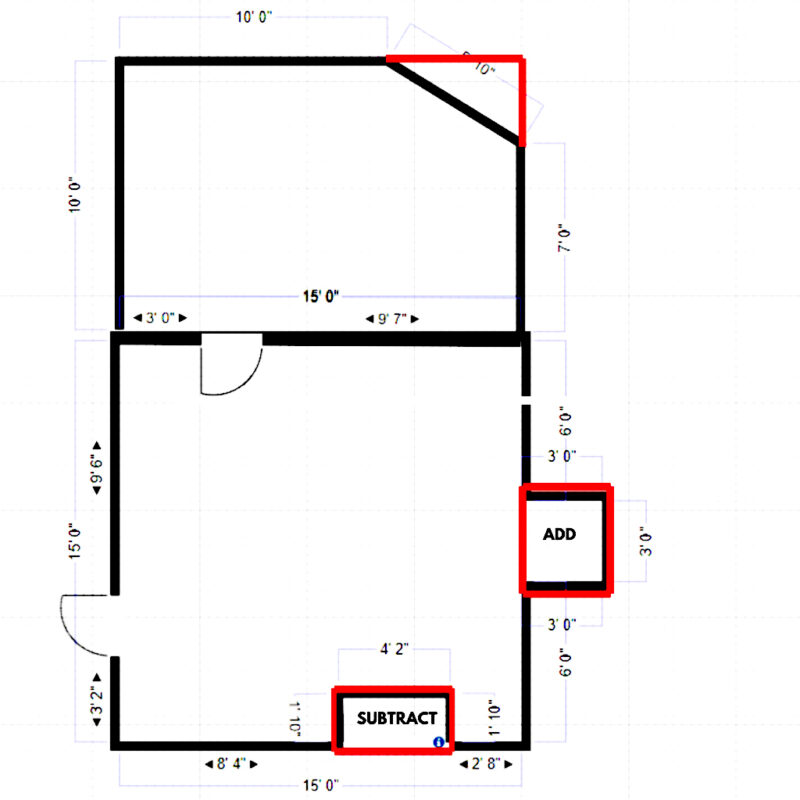
Things start to get trickier when you’re dealing with oddly shaped spaces. Nooks and crannies are part of the design in many homes, but they easy to calculate. You just need to be prepared to take additional measurements and do more diligence in double-checking your calculations.
Begin by sketching your room’s general layout on a piece of paper. Take into account the main walls, as well as any incoves, outcoves or stairways. Break the room up into rectangles since they are easier to measure.
Treat your first measurement as if your room were square or rectangular. Measure and record your room’s longest length and widest width, then multiply to obtain your room’s general area.
Once you have your room’s general square footage, you can begin measuring each nook and cranny. In your notebook, make two columns — one for incoves, which you will later subtract, and one for outcoves, which you will later add, to keep track of what you need to do with each measurement. For small nooks and crannies, you can round your square footage up to account for these tiny irregularities. If your room has larger nooks and crannies, measure each one individually to obtain a more accurate estimate.
For nooks and crannies with squared edges, measure them as you would a regular square room, and take their length and width measurements. If your incoves or outcoves have rounded edges, imagine that they were straight and draw a rectangle around each one to square them out. Make sure the imaginary rectangle goes beyond the rounded incove or outcove lines rather than within it to avoid under measuring.
Multiply your width and length measurements of each nook and cranny to get each one’s square footage. For incoves, subtract their square footage from your first general square footage calculation of the whole room. For outcoves, add their square footage to the room’s total square footage.
After reaching your new total square footage calculation, add 7-15% to account for the hardwood flooring waste factor.